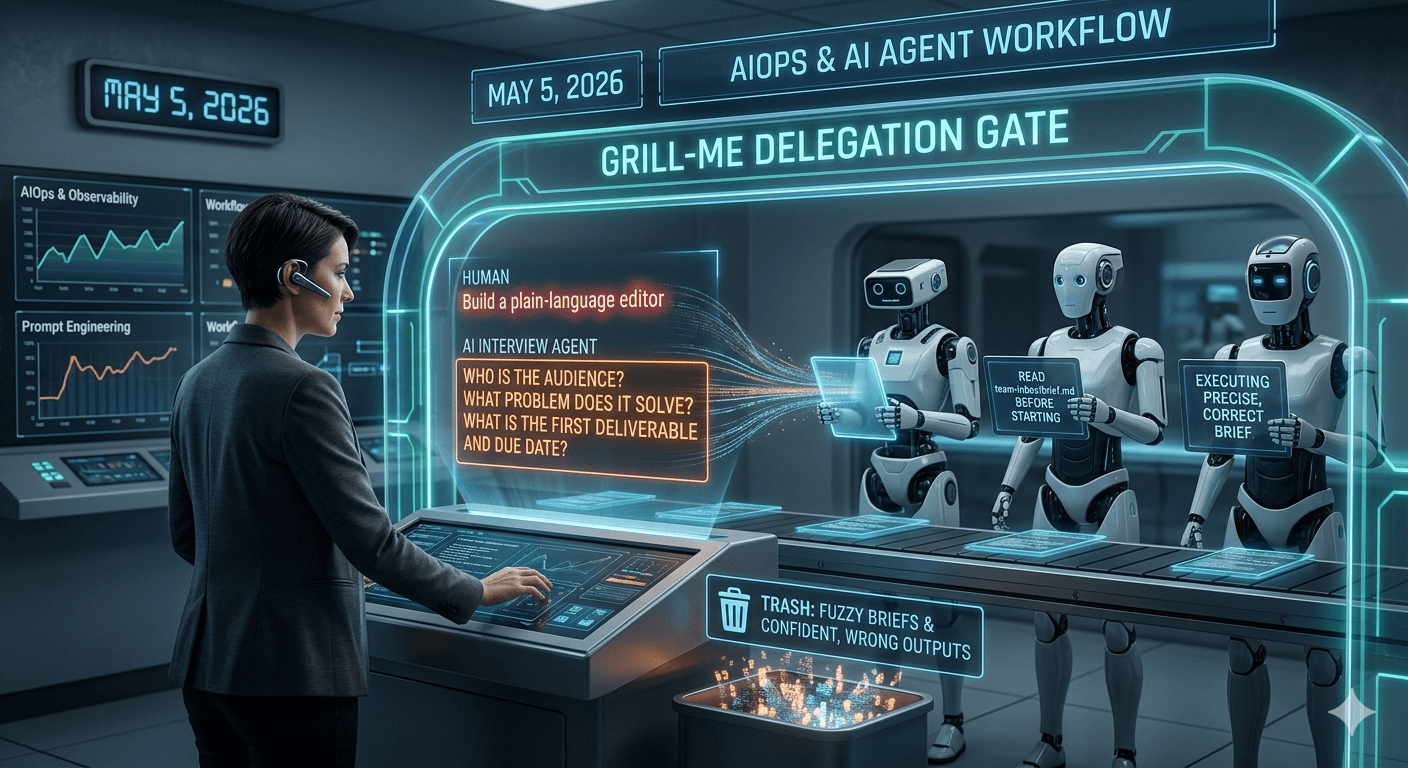
The problem with a multi-agent team is not that the agents are bad at their jobs. It is that a vague brief reaches them and they execute it precisely. A fuzzy input produces a confident, well-structured, completely wrong output.
grill-me is an interview technique by Matt Pocock (aihero.dev). The AI asks targeted questions one at a time to surface hidden assumptions before you start building -- structured rubber ducking with a summary at the end. It was designed for solo developers thinking through their code. I adapted it for a different problem.
The gap it fills
When I work alone and I am about to build something, the risk is that I start on the wrong thing. grill-me surfaces that before I write a line.
In a multi-agent setup, the risk is different. I am not the one executing the work. An agent is. If I hand off a vague brief, the agent fills in the blanks with its own assumptions and produces something coherent that does not match what I wanted. I find out when I read the output, not before.
The fix is to make the brief tight before it leaves my hands. grill-me does that. The question is when to run it.
Running it on every brief would be annoying and wasteful. Most briefs are fine. So I defined three specific triggers. If any of them are present, grill-me runs before anything gets delegated.
The three triggers
Trigger 1: a product or feature without a named audience.
"We should build a plain-language editor" is not a brief. Who is it for? A 55-year-old civil servant writing policy documents, a junior developer writing error messages, or a copywriter trying to hit a reading level? The tool is different in each case. If I cannot name the audience, I do not know what I am building.
Trigger 2: "we should" statements without a deadline or an inciting problem.
"We should do something about our SEO" or "we should write more documentation" -- these are observations, not tasks. They float in the backlog forever because they have no start condition. A "we should" without a specific problem that made me say it, or without a date by which it matters, is not ready to delegate.
Trigger 3: large scope words without a first deliverable.
"Build a platform." "Run a campaign." "Redesign the onboarding." Each of these could mean three days of work or three months. An agent given "build a platform" will make a dozen scope decisions I did not authorize. If I cannot name what done looks like for the first two days, the brief is not ready.
Why I run it in the main chat, not through an agent
I considered creating a dedicated interview agent. I did not, for one reason: the interview is a conversation, not a task.
The value of grill-me comes from the back-and-forth. A question reveals something, my answer shifts what the next question should be, and the final summary reflects the full exchange. That loop belongs in main chat, where it affects what I do next in real time.
If I route it through an agent, the output goes into a task queue. The agent returns a summary. I read it, synthesize it, and then write the actual brief. That is two steps where one works. The interview is for me, not for the agent.
The artifact rule
Every grill-me session produces a file. No exceptions.
The reason is /compact. When Claude Code compresses conversation history, inline notes from a session disappear. The conclusions from a 20-minute interview are gone. A file in Team Inbox is not gone.
The file is short. Five to ten lines covering:
- Who the audience is (named, specific)
- What problem the product or feature solves for them
- What the first deliverable is and when it is due
- Any questions still open
That file gets referenced by name in the delegation prompt to the downstream agent. "Read team-inbox/plain-language-editor-brief.md before starting" is a better handoff than a paragraph of inline context that may or may not survive the next compaction.
What this actually changes
The outcome is not that every brief is perfect. It is that the gap between what I hand off and what the agent produces gets smaller.
Before the gate existed, I noticed a pattern: I would give a brief that felt clear to me, an agent would produce something technically correct, and I would spend time revising it in a direction the agent could not have predicted. The brief had hidden a decision I had not made.
grill-me forces that decision before the agent starts. The interview takes five minutes. Revising an agent's output that went in the wrong direction takes longer.
The triggers are the part that makes it sustainable. I do not run the interview because I think I should. It runs when specific conditions are met. That removes the judgment call about whether this particular brief is clear enough -- the conditions either match or they do not.
Setting it up
The triggers live in the team lead's instructions. Any time I give an input that matches one of the three patterns, the session switches into interview mode before doing anything else.
The interview follows Matt Pocock's approach: one question at a time, targeted, no compound questions. The session ends with a structured summary. I write the summary to a file and use the file path in the next delegation.
The grill-me skill runs in main chat. The artifact goes to Team Inbox. The downstream agent reads the artifact. That is the full loop.
The thing it does not solve
grill-me is good at surfacing the assumptions inside a brief. It is not good at telling you whether the brief is the right thing to work on.
If I come in with a clearly defined audience, a specific problem, and a first deliverable -- but it is the wrong problem -- the interview will not catch that. Prioritization is a separate question. The gate only checks whether the brief is specific enough to delegate safely. Whether it should be in the queue at all is a decision I make before I open a chat.
That separation is intentional. One gate, one job. A gate that tries to evaluate both specificity and priority would need to know too much about the overall strategy to be useful as a check on any individual brief.
grill-me is a technique by Matt Pocock at aihero.dev.